Health & Safety
Pet Odors and Potential Health Risks in Jacksonville and St. Johns Yards
If your backyard has started to announce itself before you get to the patio door, you are not imagining it and this is a very common problem. Florida yards smell worse than yards almost anywhere else in the country, and they get there faster.
Here is the part most homeowners get stuck on: scooping the yard does not always fix the smell. People hire a service, the piles are gone, and one corner of the patio still turns their stomach in August. That is not a company doing a bad job. It is a different problem with a different fix.
Doody Daddy offers a deodorizer treatment for exactly that, added on to your regular visits. Below is what it is, when it is worth adding, and whether it is safe around your pets and kids.
Why does a yard smell worse in Florida than up north?
Odor from pet waste is a biological process, and that process runs on heat and moisture. Northeast Florida supplies both in quantity.
Heat and humidity speed everything up. A pile that would sit fairly inert for a week in October can turn a corner in two days in July. That is why so many homeowners tell us the yard was fine all winter and became a problem overnight in May.
Afternoon storms move it around. A hard summer rain does not rinse waste away. It breaks piles apart and spreads the material across the lawn, into the mulch beds, and along the fence line. What was one spot you could avoid becomes a thin layer you cannot.
Sandy soil does not absorb the way people expect. It drains quickly, which is different from neutralizing anything. The nitrogen and the odor compounds stay near the surface.
St. Augustine grass hides the source. That thick, spongy canopy is great for a Florida lawn and terrible for finding waste. Piles disappear under the runners within a day or two, which is how a yard reaches “why does it smell out here” before anyone can see a reason.
Hard surfaces are the worst offenders. Screened lanais, paver patios, artificial turf, and concrete dog runs have nowhere for urine to go. It sits, it bakes, and the ammonia concentrates. Homeowners in Nocatee, Ponte Vedra, and the newer St. Johns communities run into this constantly, because those neighborhoods have a lot of pavered outdoor living space and a lot of turf.
And this is why scooping alone falls short. Removal solves the solid waste. It does nothing about urine, because there is no pile to pick up. On an open lawn, rain and time eventually handle most of it. On those hard surfaces it has nowhere to go and it builds up week after week. So if your yard is being cleaned on schedule and one area still smells, it is almost certainly urine rather than waste that got missed. If you do think waste is being missed, tell us and we will send the technician back or issue a credit, no argument.
How do I get rid of the smell in my yard?
What works:
- Removing the waste, consistently. Unglamorous and still the most effective thing on this list. Frequency beats intensity: a yard cleared weekly never reaches the state that produces serious odor in the first place.
- Getting the waste off the property. Bagged waste sitting in a bin through four days of Florida heat is still generating odor, just closer to your garage.
- Rinsing hard surfaces with water, then letting them dry fully. For pavers and artificial turf, dilution and drying genuinely help. Standing water does not.
- An enzyme treatment made for urine odor. The one thing on this list that reaches urine a rinse cannot. Doody Daddy offers it as a deodorizer treatment, covered in the next section.
What does not work:
- Hosing waste into the lawn or the street. This removes nothing. It spreads bacteria across a wider area and sends the rest toward the storm drain.
- Bleach. It kills grass and does not sanitize soil in any practical sense. More important: never mix bleach with anything containing ammonia, including urine. The combination produces chloramine gas, which is genuinely dangerous.
- Lime. Agricultural lime adjusts soil pH, it does not sanitize. Hydrated lime is caustic and can burn paws and skin.
- Air fresheners and scented sprays. They add a second smell to the first one.
What is a deodorizer treatment?
Doody Daddy offers a deodorizer treatment as an add-on to regular pet waste removal. When scooping has not fully solved the smell, the cause is urine, and that is what the treatment is built for.
It is a blend of natural enzymes applied to your yard to eliminate the smell of pet urine. Enzymes break down the compounds producing the odor rather than masking them with a scent, which is why it works where hosing alone does not.
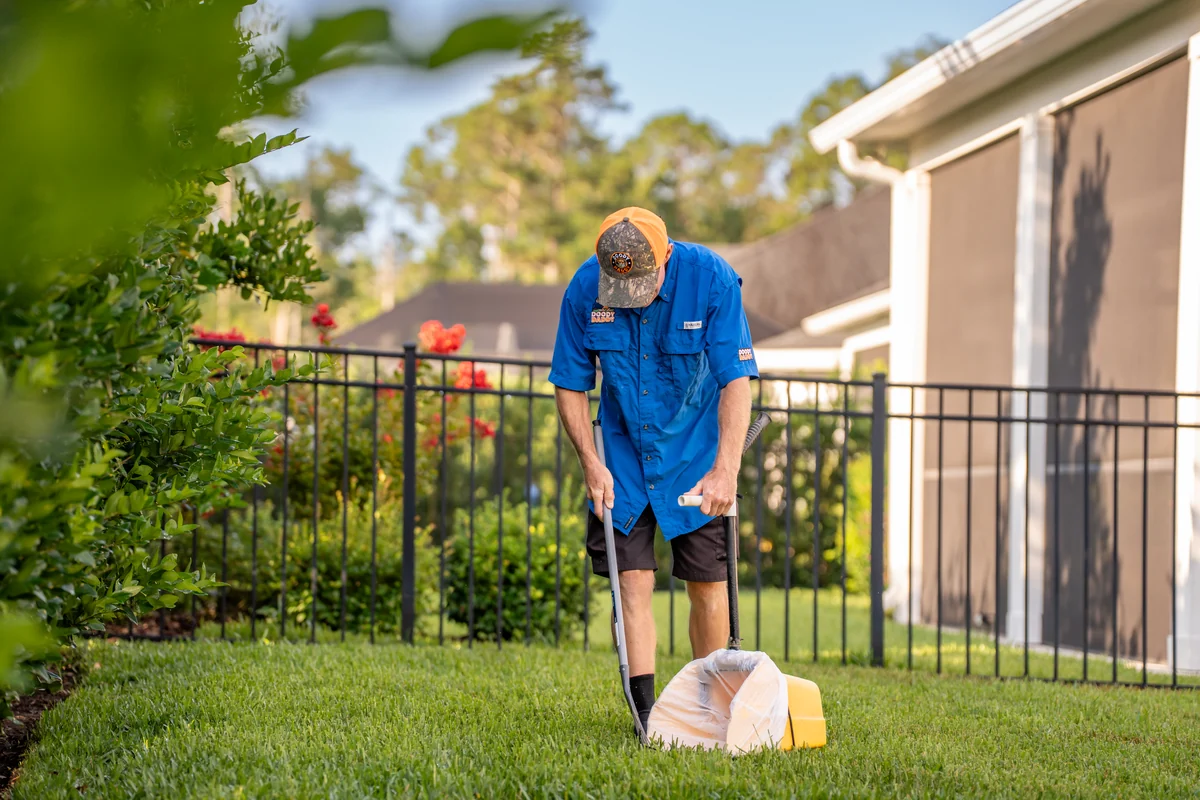
It is not a separate appointment. The treatment is applied on the same schedule as your visits, so if you are on weekly service, it happens weekly. That matters, because urine odor is a recurring condition rather than a one-time mess. Treating it once does not hold.
It covers the whole yard, not one corner. Every area we service on your visit gets the treatment: open grass, concrete dog runs, artificial turf, and the hard surfaces where urine has nowhere to drain. Odor rarely stays in one spot, so treating one spot rarely fixes it.
It costs $12 per treatment. That is a flat add-on to your visit, not a separate trip charge and not a quote based on yard size. We recommend it weekly, on the same schedule as your service, because urine odor rebuilds between visits. Every other week is available if you would rather start there.
Worth adding if: you have a covered lanai, patio, or artificial turf, a concrete dog run, multiple dogs using the same small area, or one spot that still smells no matter how often the yard is cleared.
Probably not worth adding if: your yard is open grass, you have one dog, and the odor cleared up once regular service started. We will tell you that during the quote rather than adding it to your invoice.
For HOAs, apartment communities, and commercial properties, the deodorizer treatment is available alongside pet waste stations, trash can service, and common area cleanup. It is most often used around waste station areas and high-traffic pet relief zones.
Is the deodorizer treatment safe for my pets?
Yes. That blend is formulated to be safe for your yard, your pets, and your family.
That is the entire reason we use enzymes rather than a harsh chemical. This goes on the grass your dog lies down in and the patio your kids walk across barefoot. A product that required you to keep everyone off the yard afterward would defeat the purpose of the service.
We ask that dogs come inside while we are in the yard. That is the one thing we need from you on service day. It keeps the visit quick, it removes any chance of a dog slipping out behind the technician, and it is why the heads-up text matters: it gives you a few minutes to get everyone in before we pull up.
If you have a dog with skin sensitivities or a specific health condition, mention it when you request your quote and we will talk it through before we apply anything.
Can I just get the treatment and skip the waste removal?
We do not offer it that way, and the honest reason is that it would not solve your problem. A deodorizer handles urine odor. It does nothing about the piles, and the piles are the part that matters most, because waste sitting in a yard for weeks is what turns a nuisance into a health question.
Odor control is the finishing step after removal, not a replacement for it. Anyone who sells you odor treatment alone and tells you the yard is handled is selling you a scent.
Health Effects due to Pet Waste
Most of the worry about dog waste comes down to one thing: how long it sits.
Fresh waste is mostly a nuisance. Old waste is the real problem. According to the CDC, roundworm eggs need about two to four weeks in the environment before they can infect anyone, and hookworm larvae need about one to two weeks in damp, sandy soil. Waste that leaves your yard every week never gets there.
Hookworm is the one to know about in Florida. The larvae can get through bare skin and cause an itchy rash, and the Southeast has the highest rates in the country. If your kids play barefoot in a sandy part of the yard, that is the risk that actually matters, more than anything you can smell.
The smell itself is usually not the problem. Ammonia from dog urine in an open yard is unpleasant, not dangerous. Enclosed spaces are different. A screened lanai with poor airflow, a garage the dog uses on rainy days, or a small covered patio in August can build up enough ammonia to bother eyes and airways and make asthma worse. If someone in your house has trouble in one spot outside and nowhere else, that spot needs attention.
And it does not stay in your yard. The City of Jacksonville puts the figure at as much as 23 million fecal coliform bacteria in a single gram of dog waste, and names pet waste as a major contributor to stormwater pollution. Rain carries it to the street, into storm drains, and from there into the creeks and the St. Johns River untreated. On the First Coast, the drain at the end of your street is not far from water people fish and paddle in.
None of this is cause for panic. It is just the case for staying on a schedule.
Is Doody Daddy safe around my dog?
Fair question, and a more important one than most companies acknowledge. You are letting someone walk through the space your dog lives in.
Sanitized tools between every single yard. This is the one that matters most, and the one worth asking any company about. Giardia and parvovirus travel between properties on rakes, scoops, and boots. A crew running the same unsanitized equipment through fifteen yards in a day can carry your neighbor's problem into your grass. If you are comparing providers, ask each one directly and listen to how fast they answer.
The gate gets checked before we leave. Every visit. It is a checklist item, not a habit we hope holds. An escaped dog is the worst thing that can happen on a route and we treat it that way.
Uniformed, background-checked technicians, and the same crew on the same day. You should be able to look out the window and know immediately who is in your yard.
A heads-up before we arrive. Customers consistently tell us the text before the visit is what makes the service work with dogs, because it gives them a few minutes to bring everyone inside. You also get a notification once the visit is complete.
If your dog is reactive, anxious around strangers, or recovering from surgery, tell us when you request service. We would much rather build the route around that than find out on the first visit.
Ready for a yard you do not have to think about?
The fix for pet odor is not a product. It is not letting the yard get there in the first place, and treating the urine that scooping cannot reach.
Weekly service starts at $19 a week for one dog. No contract, no signup fee, no fuel surcharge.
Request service online, or call (904) 826-9235 to speak with our team Monday through Friday, 9 a.m. to 5 p.m. Ask about the deodorizer treatment when you do and we will tell you honestly whether your yard needs it.
We proudly serve: Jacksonville, Ponte Vedra Beach, Mandarin, Orange Park, Fleming Island, Nocatee, Palm Coast, Fernandina, Yulee, World Golf Village, St. Augustine, and St. Johns.